Barcode Printer Supplier in Kolkata – DCode International
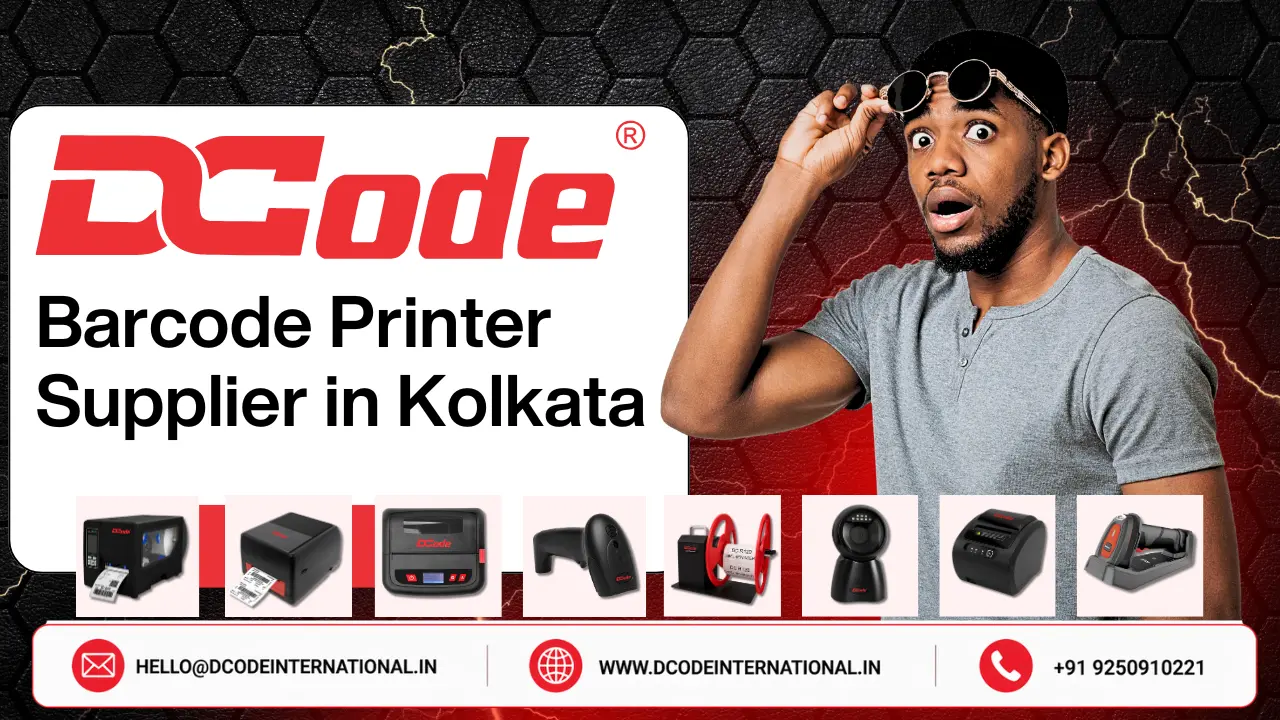
Kolkata is a city where traditional commerce and modern business technology operate side by side. Walk through Burrabazar, visit a modern retail chain, look at a warehouse in the industrial belt, or follow the movement of an e-commerce parcel, and you will find one common requirement: accurate identification of products, packages, inventory and transactions. That is where barcode printing becomes much more than simply printing a sticker. A properly printed barcode becomes a digital identity for a product, carton, asset or shipment, allowing businesses to connect physical items with software systems, inventory records and operational workflows. For companies searching for a barcode printer supplier in Kolkata, DCode International is a supplier worth considering because its product ecosystem extends beyond a single printer category into scanners, mobile printers, receipt printers, printheads and broader identification technologies.
DCode International’s current product information covers label printers, receipt printers, mobile printers, barcode scanners, printheads and other Auto-ID products. Its India-facing material also identifies Kolkata among the markets it serves, making DCode relevant for businesses looking for barcode-printing solutions without limiting themselves to a basic standalone printer. The company describes its broader capabilities around barcode, RFID, IoT and identification solutions, while its current product portfolio includes desktop-style label printers as well as mobile and industrial-oriented equipment. This makes the DCode barcode printer range in Kolkata relevant for retailers, warehouses, manufacturers, logistics companies, healthcare organizations, e-commerce sellers and other businesses that need consistent identification and labeling.
Why Barcode Printing Matters for Kolkata Businesses
Think about a warehouse containing thousands of products. If every product has to be identified manually, employees have to read product codes, enter information, double-check quantities and then update the software. It is slow, repetitive and surprisingly vulnerable to human error. A barcode changes the equation. Instead of asking a person to remember or manually type a long product identifier, the business can print that information into a machine-readable format and scan it whenever the item moves through the operation. This simple process can make receiving, inventory counting, picking, packing, dispatching and billing much more systematic.
For Kolkata businesses, this matters because the commercial environment is incredibly diverse. Retailers may need small product labels, distributors may require carton labels, manufacturers may need production identification, logistics companies may print shipping information, and e-commerce sellers may need labels every day at considerable volume. A barcode printer gives these businesses control over the labeling process instead of relying entirely on ordinary office printers or outside printing vendors. Once a company begins printing labels internally, it can create labels when required, update information quickly and standardize its identification system. The real value is not simply the printer itself; it is the workflow that develops around it. A reliable printer becomes a small but important part of the company’s operational infrastructure.
Barcode Printers vs. Conventional Printers
An ordinary office printer is designed primarily for documents, presentations and general-purpose printing. A barcode printer has a very different job. It is engineered around labels, tags, receipts or other specialized media and is designed to produce machine-readable symbols consistently. That distinction becomes important when a business prints hundreds or thousands of labels because barcode quality is not something you want to leave to chance. A barcode that looks acceptable to the human eye may still become difficult for a scanner to read if the resolution, contrast, sizing or printing method is inappropriate.
Thermal printing is particularly useful because it avoids many of the complexities associated with traditional ink-based printing. Depending on the printer and media, businesses can use direct thermal printing or thermal transfer printing. DCode’s label-printer portfolio includes models designed around these thermal technologies, with specifications covering resolution, print speed, connectivity and print width. For example, the company’s DC421 Pro is positioned as a 4-inch-class label printer supporting both thermal transfer and direct thermal printing, while marketplace information currently lists USB and LAN connectivity, 203 DPI resolution and printing speeds up to 152 mm/s for this model.
DCode International as a Barcode Printer Supplier
Choosing a supplier is different from choosing a printer. The machine may be sitting on a desk for several years, so the supplier behind that machine matters almost as much as its specifications. Businesses should consider whether the supplier understands barcode applications, whether it can recommend an appropriate printing technology, whether compatible consumables are available, and whether technical assistance is accessible when something goes wrong. A low-cost printer that creates operational problems can become much more expensive than a slightly higher-priced printer that performs consistently.
DCode International positions itself as a provider of barcode and automatic identification solutions rather than simply a printer seller. Its current portfolio includes barcode scanners, label printers, mobile printers, receipt printers, printheads and related technologies, while its India-facing company information describes solutions spanning barcode, RFID, IoT, DPM, labels, software and consumables. That broader ecosystem can be useful when a business eventually wants to move beyond printing and create a more connected identification workflow. A company may start with a barcode printer today, add handheld scanners later, introduce mobile printing for warehouse operations, and eventually integrate RFID or software solutions as its requirements grow.
Product Range and Technology
The biggest advantage of looking at a supplier with a broad portfolio is that you can match the printer to the actual application rather than forcing every business problem into the same hardware. A small retailer printing narrow labels does not necessarily need the same equipment as a manufacturing unit printing durable product identification labels. Similarly, a delivery operation may benefit from a compact mobile printer instead of a desktop printer positioned permanently at a workstation.
DCode’s current online portfolio illustrates this range. Its label-printer category includes compact printers with different paper widths and connectivity options, while its mobile-printer portfolio includes battery-powered models designed for printing away from a fixed desk. The company’s scanner range includes wired, wireless and 2D scanning options, giving businesses the possibility of building a connected printing-and-scanning workflow. The label-printer specifications published by DCode include models with USB, Bluetooth and LAN connectivity, while mobile models are described as supporting Windows, Android and iOS environments depending on the model.
Business-Focused Barcode Printing Solutions
A barcode printer should be selected according to the business process, not simply according to the number printed on a quotation. Ask a different set of questions. What are you printing? How many labels do you print each day? What is the label size? Will the label face heat, moisture, friction or chemicals? Do you need direct thermal or thermal transfer printing? Will the printer remain at a workstation, or does an employee need to carry it?
These questions reveal why a professional barcode printer supplier can be valuable. A good solution may involve the printer, labels, ribbons, software, scanners and integration together. For example, a warehouse may require a thermal-transfer printer for durable carton or asset labels, handheld scanners for inventory movement and a mobile printer for on-floor operations. A retail store may have a completely different setup based around product labeling, receipts and POS integration. DCode’s broader portfolio makes it possible to consider these components as part of one technology ecosystem instead of treating each purchase as an isolated transaction.
Types of Barcode Printers Available
There are two major thermal printing approaches that businesses should understand before purchasing a barcode printer: direct thermal and thermal transfer. Direct thermal printing creates an image through heat-sensitive media. It can be attractive for applications where labels have a relatively short useful life, such as certain receipts, temporary shipping labels, tickets or short-term identification. Thermal transfer printing uses a ribbon to transfer ink onto the label material, which can provide better durability for applications where labels must remain readable for longer periods.
Neither technology is universally better. It depends on the application. Imagine two businesses: one needs labels that remain on parcels during a short delivery journey, while another needs product identification labels that remain attached to industrial components for months. The first application may be perfectly suited to direct thermal printing, while the second may benefit from thermal transfer. DCode’s portfolio includes both direct thermal and thermal-transfer capabilities across its product range, allowing buyers to evaluate the technology according to their actual use case rather than choosing a printer simply because it is inexpensive.
Direct Thermal Barcode Printers
Direct thermal printers are popular because they can offer a straightforward printing workflow. Since the image is generated directly on heat-sensitive media, there is no thermal-transfer ribbon involved in the printing process. That can simplify consumable management and make the technology useful for applications where the label does not need to survive harsh long-term conditions.
For businesses in Kolkata, direct thermal printing can be useful in retail, transportation, courier operations, temporary inventory identification and many other situations. A business that prints shipping labels today and expects those labels to remain readable only through the delivery process may have different requirements from a manufacturer that needs a label to remain intact for years. DCode’s product range includes direct thermal models and combination printers, including compact label and receipt products. Its published specifications show options with USB and Bluetooth connectivity and, for certain models, LAN connectivity as well. This range gives businesses flexibility when connecting printers to POS systems, computers, tablets or mobile workflows.
Thermal Transfer Barcode Printers
Thermal transfer printing is often the better choice when label durability is a priority. Instead of relying solely on heat-sensitive label stock, the printer uses a ribbon to transfer the image onto the label material. Depending on the ribbon and label combination, this can produce labels designed to withstand more demanding environments. That makes thermal transfer especially relevant for manufacturing, warehousing, asset identification, outdoor-related applications and products that need identification for longer periods.
DCode’s DC421 Pro is one example of a printer designed to support both thermal transfer and direct thermal printing. Current product information describes the model as a 203 DPI printer with a maximum print width of 104 mm and a maximum print speed of 152 mm/s, with USB and LAN connectivity and ribbon capacity up to 300 metres. Those specifications illustrate why businesses should evaluate more than just the printer’s purchase price. Ribbon capacity, print width, speed, resolution and connectivity all affect how effectively the printer fits into an operational environment.
DCode Barcode Printer Models for Different Applications
There is no single “best barcode printer” for every company. The correct choice depends on label dimensions, volume, material, printing speed, required resolution, connectivity and the environment in which the printer will operate. A small business printing a few hundred labels a week may prioritize affordability and simplicity. A warehouse printing continuously may prioritize duty cycle, media capacity and serviceability. A manufacturer may prioritize thermal-transfer capability and durable output.
DCode’s portfolio reflects this range. Its label-printer category includes compact models as well as wider-format options, while its mobile-printer range addresses situations where printing needs to happen away from a fixed workstation. The company’s scanner portfolio also includes wired, wireless and 2D devices, which can complement a barcode printer in a complete identification workflow. This is particularly useful for companies that expect their barcode requirements to grow over time. Rather than replacing the entire system every time a new operational requirement appears, they can expand their hardware around a common identification strategy.
DC421 Pro for Everyday Label Printing
The DCode DC421 Pro is particularly relevant when a business needs a conventional 4-inch-class desktop label printer for everyday operations. Current product information lists thermal transfer and direct thermal printing, 203 DPI resolution, a maximum print width of 104 mm, a maximum print speed of 152 mm/s, USB and Ethernet/LAN connectivity and ribbon capacity of up to 300 metres. These specifications make it suitable for a wide range of general barcode-label applications where businesses need a balance of printing flexibility and connectivity.
The DC421 Pro also demonstrates an important purchasing principle: specifications should be interpreted according to workflow. A 203 DPI printer can be perfectly appropriate for many standard barcode labels, but very small labels or high-density graphics may require a higher-resolution model. Similarly, LAN connectivity can be useful in environments where multiple computers or workstations need access to a shared printer. Current Kolkata marketplace listings also show the DC421 Pro appearing among barcode-label printer offerings, indicating that DCode hardware is represented within the local market.
Barcode Printers for Retail and Supermarkets
Retail businesses deal with an enormous number of small decisions every day: pricing, inventory, replenishment, product identification, billing and stock movement. Barcode labels connect many of those activities. When a product is properly labeled, staff can scan it instead of manually entering product information, helping speed up routine processes and reduce unnecessary typing.
For supermarkets, specialty stores, electronics retailers, apparel businesses and wholesalers, the right barcode printer can be used for product labels, shelf identification, inventory tags and other operational requirements. The important factor is consistency. If labels are printed at inconsistent sizes or with poor contrast, scanners may struggle, creating the very problem the barcode system was supposed to solve. A thermal barcode printer provides a dedicated way to maintain standardized output. DCode’s portfolio includes both label printers and scanners, so a retailer can consider the printing and scanning sides of the workflow together. Its scanner range includes 1D and 2D options, with wired, Bluetooth and wireless configurations available across models.
Barcode Printing for Warehousing and Logistics
Warehouses are where barcode technology can become particularly powerful. Every movement can represent a data event: goods arrive, items are inspected, stock is stored, products are picked, cartons are packed and shipments are dispatched. If each physical item or package has a machine-readable identifier, scanning can connect those physical movements to the warehouse management system.
A warehouse in Kolkata handling FMCG products, spare parts, electronics, apparel or e-commerce orders may have very different labeling requirements from a small retail outlet. High-volume operations may need faster printing, larger media capacity, LAN connectivity and durable labels. Employees working away from fixed stations may also benefit from mobile printers. DCode’s product range includes mobile printers that support wireless connectivity and portable workflows, while its scanner portfolio includes wireless and 2D models for inventory and logistics applications. This creates the possibility of combining stationary label printing with mobile scanning and printing as part of a more flexible warehouse operation.
Barcode Printers for Manufacturing
Manufacturing environments often need labels that do more than identify a product. A label can contain a serial number, batch number, production information, part number, date, barcode or other traceability information. When manufacturing processes become more complex, reliable identification becomes increasingly important because the label may connect a physical component with production records, inspection information and inventory data.
Thermal transfer printers can be particularly useful when the label must remain readable under demanding conditions. The right combination of printer, ribbon and label material can help create durable identification. For manufacturing businesses in and around Kolkata, printer selection should therefore consider environmental conditions as seriously as print speed. A printer may look excellent on a specification sheet but still be unsuitable if the chosen media cannot survive the environment where the label will be used. DCode’s broader barcode and Auto-ID portfolio can help businesses consider printers alongside scanners and other identification technologies rather than treating the label printer as an isolated device.
Barcode Solutions for Healthcare and Pharmaceuticals
Healthcare and pharmaceutical environments depend heavily on accurate identification. Labels may be used for medicines, samples, inventory, patient-related workflows, laboratory items, equipment or storage locations. In these environments, the quality of identification can directly influence operational accuracy, which makes reliable barcode printing particularly important.
The printer should be selected according to the label’s purpose. Small labels may require appropriate resolution, while labels exposed to moisture or frequent handling may require more durable materials and thermal-transfer printing. Businesses should also consider the software used to generate labels and whether the printer can integrate smoothly with existing systems. DCode describes its solutions as serving sectors including healthcare, retail, logistics and warehousing, and its portfolio extends from printers to scanners and other identification technologies. That breadth can be useful for organizations planning a broader barcode workflow rather than purchasing a printer without considering the rest of the system.
Barcode Printers for E-Commerce Businesses
E-commerce has made barcode and shipping labels an everyday operational requirement for many businesses. Even a relatively small online seller may eventually have to print product labels, order labels, shipping labels, return labels and inventory identification tags. As order volume grows, manual labeling quickly becomes a bottleneck.
A dedicated barcode printer can help bring structure to this process. Instead of printing labels on A4 sheets and cutting or separating them manually, businesses can use dedicated label media designed for thermal printing. The result can be a faster workflow with less paper waste and more consistent label formatting. DCode’s portfolio includes compact label printers and mobile printers, which can be relevant to online sellers ranging from small businesses to larger fulfillment operations. For a growing e-commerce company, it is smart to choose hardware that can handle today’s workload while leaving room for tomorrow’s volume.
Choosing the Right Barcode Printer in Kolkata
The most useful way to choose a barcode printer is to begin with the label, not the printer. Measure the label width and height. Determine what information will be printed. Decide whether the label needs to survive for days, months or years. Estimate the number of labels printed per day and identify whether printing will happen from one computer or multiple systems.
A simple buying checklist can include:
- Printing method: Direct thermal or thermal transfer.
- Resolution: 203 DPI, 300 DPI or another requirement based on label detail.
- Print width: Match the printer to your largest required label.
- Printing speed: Consider actual daily volume rather than maximum speed alone.
- Connectivity: USB, LAN, Bluetooth, serial or other interfaces depending on workflow.
- Media: Confirm label size, material and compatibility.
- Ribbon: Required for thermal-transfer applications.
- Software: Confirm compatibility with the label-design or business software.
- Service: Understand support and replacement-part availability.
The goal is simple: don’t buy the most powerful printer you can afford; buy the printer that fits the job. A smaller printer can be a smarter investment when the application is light, while a more robust model can save money over time when printing volume is high.
Connectivity, Resolution and Printing Speed
Three specifications frequently appear in barcode printer comparisons: resolution, speed and connectivity. Resolution is usually expressed in DPI and affects how finely the printer can reproduce text, barcodes and graphics. Standard labels often work well with 203 DPI, while applications involving very small text, tiny barcodes or detailed graphics may justify a higher-resolution printer.
Speed sounds straightforward, but maximum speed is not the only consideration. A printer rated at a certain speed may still perform differently depending on label size, print content, media and workflow. Connectivity is equally important. USB works well for a printer connected directly to one workstation, while LAN can make a printer more convenient in a networked environment. Bluetooth is useful for mobile workflows, particularly when printers are paired with tablets, phones or portable devices.
DCode’s current label-printer specifications illustrate these differences. Its product range includes models with USB, Bluetooth and LAN connectivity, while specific products offer different print widths and speeds. The DC421 Pro, for example, is listed with USB and LAN connectivity, 203 DPI resolution and a maximum print speed of 152 mm/s.
Labels, Ribbons and Other Consumables
Buying a barcode printer is only the beginning. Every printer needs the correct consumables, and choosing the wrong label or ribbon can cause poor print quality, adhesive problems, premature wear or scanning difficulties. A business should therefore treat media selection as part of the printer purchase instead of leaving it until after installation.
Direct thermal applications generally use heat-sensitive labels, while thermal-transfer printing requires a compatible ribbon and label material. The combination matters. Different ribbon materials and label stocks can be selected depending on durability, surface characteristics and application requirements. For example, a warehouse label exposed to regular handling may need different materials from a temporary shipping label.
DCode’s wider product ecosystem includes printheads and consumables alongside printers, while its India-facing positioning also covers labels and related barcode solutions. That matters because maintenance is easier when the business understands the entire printing system. A printhead is a consumable component, and its life can be influenced by media quality, cleaning practices, printing conditions and usage. A supplier that understands these components can help businesses avoid treating every printing problem as a printer replacement problem.
Why Local Businesses Need Reliable Technical Support
Imagine a warehouse where the barcode printer stops working during a peak dispatch period. The printer itself may not be the only issue. The problem could be a damaged printhead, incorrect media, a driver problem, network connectivity, label calibration or software configuration. Without technical understanding, an employee may spend hours troubleshooting the wrong component.
That is why supplier support should be part of the purchasing decision. Businesses should ask about installation assistance, troubleshooting, spare parts, printhead availability, software compatibility and maintenance. The cheapest quotation does not automatically represent the lowest total cost of ownership. Downtime has a cost, especially in warehouses, retail environments and production facilities where labeling is directly connected to daily operations.
Kolkata already has an active ecosystem of printing and labeling businesses, ranging from printing-equipment suppliers to custom-label manufacturers. Current local listings include businesses such as Ritika Infosys, @@ DATASCAN and Dotter Solutions LLP. This reinforces the importance of comparing not only hardware prices but also technical capability, product availability, application knowledge and after-sales support when selecting a barcode-printer partner.
DCode’s Wider Barcode and Auto-ID Ecosystem
One reason businesses may look beyond a single printer model is that identification technology rarely stays limited to printing. Once a company starts using barcodes, it often needs scanners, mobile devices, labels, software, receipt printers or additional printing stations. As the operation grows, it may also explore RFID, asset tracking, industrial scanning or automated identification.
DCode’s current company information describes a broader portfolio covering barcode scanners, label printers, mobile printers, receipt printers, scan engines and thermal printheads. Its India-facing company profile also describes barcode, RFID, IoT, DPM, software, labels and consumables as part of its solution landscape. That broader capability can make sense for businesses that want to build a scalable identification system rather than repeatedly purchase disconnected products from different suppliers.
DCode vs. Other Barcode Printer Suppliers in Kolkata
Searching for a barcode printer supplier in Kolkata will produce many options. Local marketplaces currently show hundreds of barcode-label printer listings and a mixture of manufacturers, distributors, service providers and trading companies. Current listings also show DCode products such as the DC421 Pro alongside other brands and models.
The right comparison should therefore go beyond brand names. Look at the printing technology, actual specifications, warranty, service, consumables, spare parts, software compatibility and expected workload. A supplier may offer a very low upfront price but provide limited technical support, while another supplier may provide a more complete solution with better application guidance. Businesses should also be careful with online prices because marketplace prices can change and may represent different configurations, taxes, availability or seller conditions.
For a business considering DCode, the practical approach is to explain the application first and ask for the appropriate model. The supplier should then match the printer, label media, ribbon if required, software and scanner to the workflow. That approach is far more reliable than choosing a model simply because it appears near the top of a search result.
How Much Does a Barcode Printer Cost in Kolkata?
There is no single fixed price for barcode printers because the market includes compact direct-thermal devices, desktop label printers, industrial printers, mobile printers and high-resolution models. Current marketplace information provides an indication of the range: Kolkata listings include models around the ₹10,000–₹25,000 level, while more advanced or specialized equipment can cost considerably more. A current TradeIndia listing, for example, shows a DCode DC421 Pro at approximately ₹11,500 in one listing, while other barcode-printer products on the same marketplace appear at different prices. These are marketplace examples rather than a universal DCode price and should not be treated as a current official quotation.
The smarter question is not “What is the cheapest barcode printer in Kolkata?” but “What is the right total cost for my application?” A ₹10,000 printer that fails to meet your required workload can be more expensive than a ₹15,000 or ₹20,000 printer that works reliably for several years. Consider the cost of labels, ribbons, printheads, maintenance, downtime and replacement equipment. When these factors are included, the purchasing decision becomes much clearer.
| Requirement | What to prioritize |
|---|---|
| Small retail operation | Compact direct thermal printer |
| Product labeling | Desktop label printer |
| Long-lasting labels | Thermal transfer printer |
| Warehouse | Higher-duty printer + scanner |
| E-commerce | Shipping/label printer with suitable software |
| Mobile operations | Bluetooth/mobile printer |
| Detailed small labels | Higher-resolution printer |
| Networked workplace | LAN-enabled printer |
How to Buy the Right Barcode Printer from DCode International
The first step is to define your application. Tell the supplier what you are printing, the label dimensions, approximate daily volume, required durability and the software or system you currently use. If you already have a sample label, provide it. A real sample can often communicate more information than a long description because it shows the required barcode size, text, graphics and physical dimensions.
Next, compare the recommended model against your workflow. Check resolution, maximum print width, speed, connectivity, media compatibility and printing technology. If you need thermal transfer, confirm ribbon compatibility. the printer will be shared across multiple computers, ask whether LAN connectivity is appropriate. If employees need to print while moving around a warehouse or delivery environment, consider whether a mobile printer would be more practical.
DCode’s official India-facing information identifies Kolkata among its markets and provides a technical support contact through its product documentation. Its broader portfolio also makes it possible to evaluate printers alongside scanners, mobile printers, labels, printheads and other barcode technologies. Businesses can therefore approach the purchase as a complete solution rather than simply asking for the lowest-priced printer.
For current product information and specifications, businesses can review DCode International’s official website and compare the available printer categories before requesting a quotation. The official DCode product ecosystem currently includes barcode scanners, label printers, mobile printers, receipt printers and related identification products.
Conclusion
Finding the right barcode printer supplier in Kolkata is ultimately about finding a partner that understands how your business uses identification technology. A barcode printer is not simply another office machine sitting beside a computer. It can become part of the system that identifies products, tracks inventory, supports warehouse operations, speeds up retail processes, manages shipments and connects physical goods with digital information. That is why businesses should evaluate printing technology, label requirements, resolution, speed, connectivity, consumables, service and scalability before making a purchase.
DCode International is positioned around a wider Auto-ID ecosystem that includes label printers, mobile printers, receipt printers, barcode scanners, printheads and other identification technologies. Its India-facing materials specifically include Kolkata among the markets it serves, while current Kolkata marketplace data shows DCode barcode-printer products available within the local market.
For a Kolkata retailer, warehouse, manufacturer, logistics company, pharmaceutical business or e-commerce operation, the best printer will depend on the actual workflow. A compact direct-thermal printer may be ideal for one company, while another may need a 4-inch thermal-transfer printer with LAN connectivity and higher-duty capabilities. The key is to start with the application, understand the label, estimate the workload and then select the hardware.
When those decisions are made correctly, barcode printing stops being a simple printing task and becomes an operational advantage. That is the real reason businesses looking for a barcode printer supplier in Kolkata should evaluate DCode International not only as a printer brand, but as a potential technology partner for barcode and identification requirements.
Frequently Asked Questions
1. Is DCode International a barcode printer supplier in Kolkata?
Yes. DCode’s India-facing product documentation identifies Kolkata among the markets it serves, and its portfolio includes barcode label printers, mobile printers, receipt printers, barcode scanners and related products. Businesses in Kolkata can therefore consider DCode when evaluating barcode-printing solutions.
2. Which DCode barcode printer is suitable for general label printing?
The DCode DC421 Pro is one model to consider for general-purpose 4-inch-class label printing. Current product information lists 203 DPI resolution, thermal-transfer and direct-thermal printing, a maximum print width of 104 mm, printing speeds up to 152 mm/s and USB/LAN connectivity. The appropriate model should still be selected according to the business’s actual label size, volume and application.
3. Should I choose direct thermal or thermal transfer printing?
Choose direct thermal when the label does not need extended durability and you want a simpler ribbon-free printing process. Choose thermal transfer when the printed label needs greater durability or must remain readable for a longer period. The correct choice depends on the label material, environment, expected lifespan and application.
4. Can barcode printers be used in warehouses and logistics?
Yes. Barcode printers are widely useful for warehouse and logistics workflows involving product labels, carton identification, inventory management, shipping and dispatch. A complete workflow can combine stationary label printers, handheld barcode scanners and mobile printers. DCode’s current portfolio includes all three categories.
5. How do I get the right barcode printer for my business?
Start by providing the supplier with your label size, printing volume, required durability, barcode type, software environment and connectivity requirements. If possible, provide a sample label. The supplier can then recommend the appropriate printing technology and model instead of simply quoting a generic barcode printer. For DCode product information, specifications and inquiries, use the official DCode website.
Contact Us
Website: www.Dcodeinternational.in
Mobile no: +91 9250910221
Email: Hello@dcodeinternational.in